

Series A · Earth Before Us · Ep. 01 · 16:10 · 28 Oct 2026
What Lives at the Bottom of the Mariana Trench?
Short answer
No fish is known at the bottom of the Mariana Trench, about 6.8 miles (10,935 m) down in the Challenger Deep. The animal found there in thousands is Hirondellea gigas, a pale amphipod about 1 to 2 inches (2–5 cm) long that can digest sunken wood. Small sea cucumbers, giant single-celled xenophyophores and microbes in the mud live alongside it.
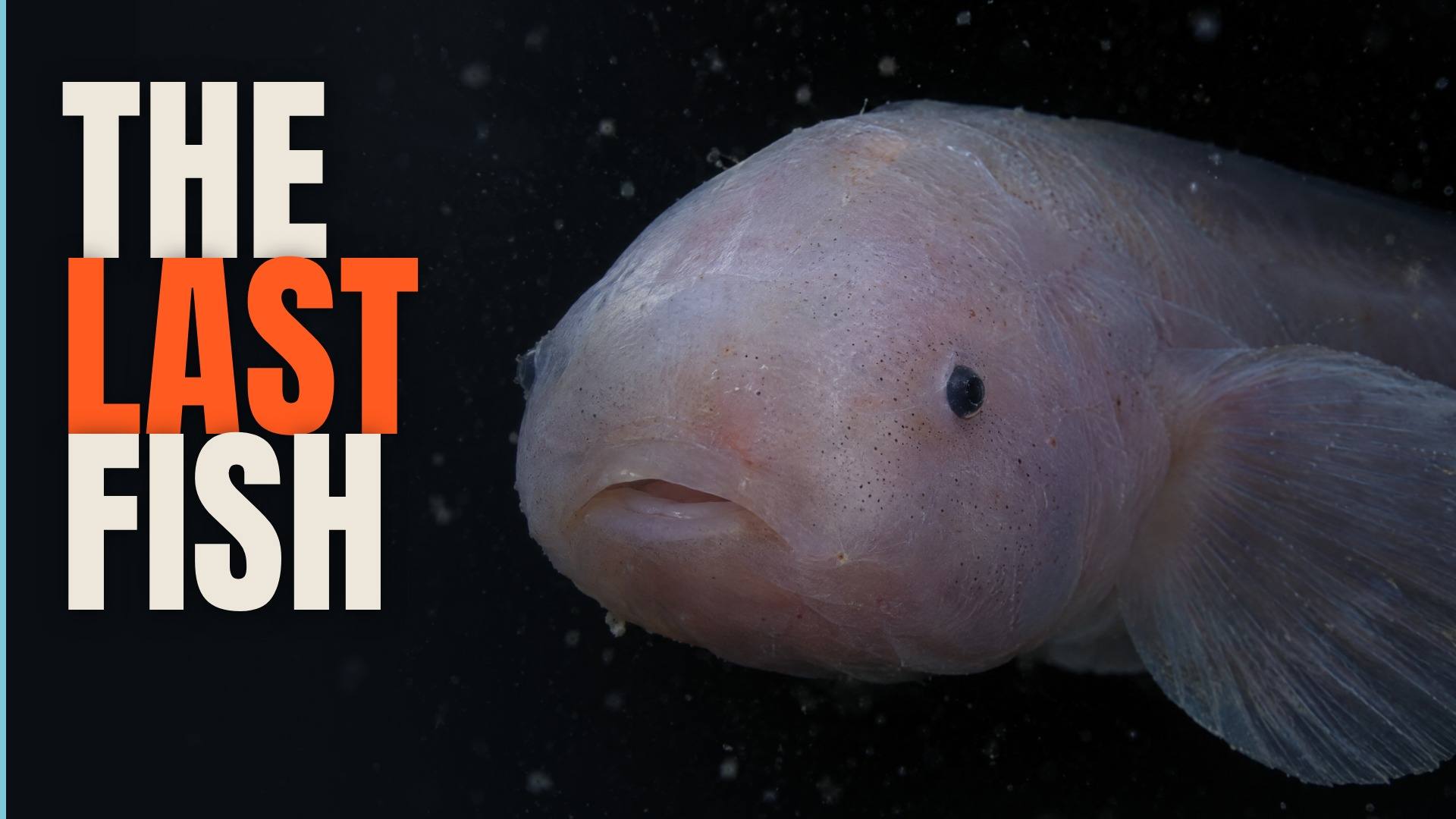
Thumbnail · AI reconstruction
Premieres WED 28 OCT · 10:00 CDMX
Set a reminder on YouTubeRead
Overview
This episode of Earth Before Us descends the Mariana Trench level by level, from the sunlit surface to the floor of the Challenger Deep, about 6.8 miles (10,935 m) down. On the way, it crosses off the animals usually placed at the bottom. Anglerfish and giant squid live thousands of feet higher, sharks are almost absent below about 9,800 feet (3,000 m), and megalodon has been extinct for more than 3 million years.
Below about 19,700 feet (6,000 m) lies the hadal zone, which works like a funnel for falling food. Its top predator is the Mariana snailfish, a soft, scaleless fish about 8 inches (20 cm) long. In 2017, a baited camera waited 17 hours and 37 minutes at about 26,800 feet (8,178 m) before one appeared: the deepest fish ever filmed in this trench. Scientists think a protective molecule, TMAO, stops fish near 26,900 feet (8,200 m), but that idea is now being questioned.
The "flatfish" reported from the Trieste in 1960 was most likely a sea cucumber. What really lives at the bottom is an amphipod, Hirondellea gigas, that can digest sunken wood. And the floor already carries traces of us: plastic filmed in 1998, man-made fibres inside amphipods, and carbon from nuclear bomb tests.
Key figures
10,935 m
Depth of the Challenger Deep
Source · NOAA Ocean Service, How deep is the ocean?
8,178 m
Deepest fish filmed in the Mariana Trench
Source · JAMSTEC 2017, deepest fish in the Mariana Trench
185 amphipods
Hirondellea gigas in one trap at 10,897 m
Source · Kobayashi et al. 2012, PLoS ONE (cellulase)
100 %
Mariana amphipods that had swallowed man-made fibres
Source · Jamieson et al. 2019, Royal Society Open Science (microplastics)
What lives at the bottom of the Mariana Trench is smaller and stranger than the monsters it is usually given. The real Mariana Trench creatures are pale and soft. Fish stop well before the floor, which belongs to a thumb-sized amphipod that can digest wood.
How deep is the Mariana Trench?
The Mariana Trench is a crescent-shaped scar in the floor of the western Pacific, east of the Mariana Islands. It runs for more than 1,500 miles (about 2,500 km).
Its deepest part, the Challenger Deep, is a group of three small basins at the southern end. NOAA, the American ocean agency, puts it at about 35,876 feet (10,935 m), nearly 7 miles; the figure shifts by a few tens of metres with the method. Mount Everest placed here would have its summit under more than a mile (about 2 km) of water.
At the bottom, the pressure is more than 1,100 times what we feel at the surface: roughly a one-tonne weight (about 2,200 pounds) resting on a fingertip. The water is only just above freezing, and completely dark.
The creatures that don’t live there
By about 3,300 feet (1,000 m), sunlight is gone completely. Below lie about 6 miles (almost 10 km) of permanent night.
The famous monsters live in the upper part of it. The anglerfish is usually found between about 330 and 4,900 feet (100–1,500 m). The giant squid hunts between about 1,600 and 3,300 feet (500–1,000 m). Neither comes anywhere near a trench.
Sharks stop far above the floor too. The deepest one ever confirmed was at about 12,100 feet (3,700 m), and below about 9,800 feet (3,000 m) they are almost absent. Around 70% of the ocean has no sharks at all, including the trench the internet keeps stocking with megalodon, a warm-water hunter extinct for more than 3 million years.
Where the hadal zone begins
At about 19,700 feet (6,000 m), the seafloor ends almost everywhere on Earth. Only trenches go deeper, into the hadal zone, named after Hades, the Greek underworld. It covers far less than 1% of the seafloor, yet it holds more than 40% of the ocean’s depth range.
It was long expected to be a desert, because almost all deep-sea food sinks from the surface as marine snow. But a trench works like a funnel. What lands on its walls slides toward the centre, and earthquakes shake more loose. After Japan’s great earthquake of 2011, more than a million tonnes of organic carbon poured into the Japan Trench; in the Mariana Trench, the effect is inferred, not measured.
Clams and giants
On the trench wall, at about 18,700 feet (5,700 m), beds of clams live on chemicals seeping out of the rock. Deeper lives the supergiant amphipod, a relative of beach sandhoppers. Most deep-sea amphipods are about an inch (2–3 cm) long; the largest of these giants ever filmed was estimated at about 13 inches (34 cm). In 2014, one was filmed alive in the Mariana Trench.
The Mariana snailfish
By about 23,000 feet (7,000 m), the trench holds enough food for something rare at such a depth: a predator. The Mariana snailfish, Pseudoliparis swirei, was only given a scientific name in 2017. It is about 8 inches (20 cm) long, scaleless, pale and translucent, and it swallows tiny crustaceans whole by suction. Mackenzie Gerringer, one of the scientists who described it, has said the fish do not look robust enough for such a place, yet they are extremely successful.
How it survives the pressure
The snailfish does not resist the pressure. It lets it in. Its skull is not fully closed, so the pressure inside its head matches the pressure outside. Much of its skeleton is cartilage, it has lost most of its vision genes and its skin-pigment gene, and it carries no pocket of air. An animal that is mostly water has very little to crush.
The real danger is to its proteins, which begin to bend out of shape at this pressure. Deep-sea fish protect them with a molecule called TMAO, and the deeper the fish, the more of it they carry. But TMAO makes the body saltier.
Where the fish stop
In 2017, a Japanese team placed baited cameras at two depths in the trench. At about 24,600 feet (7,500 m), snailfish arrived in under 4 hours. At about 26,800 feet (8,178 m), the camera waited 17 hours and 37 minutes for a single fish. No fish has been filmed deeper in the Mariana Trench. The world record, set in 2022 in a trench south of Japan, is only a little deeper: about 27,300 feet (8,336 m).
The leading explanation is TMAO. Calculations suggest that at about 26,900 feet (8,200 m), a fish would need so much of it that its body would be as salty as the sea; any deeper, and water would begin to flood into its cells. It is a hypothesis, but it fits every fish found so far. In the last 1.5 miles (about 2.5 km) of the ocean, no fish has been found.
1960: the flatfish that wasn’t
On 23 January 1960, Don Walsh of the United States Navy and the Swiss explorer Jacques Piccard sank for more than 4.5 hours in a steel sphere beneath the Trieste. During their 20 minutes on the bottom, Piccard reported a flat fish, something like a sole, about a foot long. For decades, the sighting was repeated as proof of fish at the very bottom.
It almost certainly was not a fish. In 2012, two deep-sea biologists re-examined the case and concluded it was a mistake, most likely a pale sea cucumber. No camera has ever recorded a fish there, and none is known within about 1.2 miles (2 km) of that depth.
No later visit has found one either: not a Japanese robot in 1995, not the film director James Cameron in 2012, and not the few dozen people who have gone down since 2019.
The real Mariana Trench creatures at the bottom
What the cameras did find, by the thousand, is Hirondellea gigas, an amphipod about 1 to 2 inches (2–5 cm) long. In 2009, a baited trap lowered by Japanese scientists to about 35,750 feet (10,897 m) came back with 185 of them.
In their gut, the team found an enzyme that turns cellulose, the tough fibre of plants, straight into sugar; in the laboratory, it turned dried wood into glucose. The authors concluded that the amphipod eats marine snow, carcasses and sunken plant material, including wood washed off the land and sunk through nearly 7 miles (11 km) of water.
A later study by the same group found that their shells, made of calcium carbonate, should dissolve at this depth, and that the animals appear to coat themselves in an aluminium gel drawn from the mud they swallow. Other teams have yet to confirm that finding.
Around them live small sea cucumbers and xenophyophores, giant single cells often more than 4 inches (10 cm) across. The mud beneath is alive with microbes that use up oxygen twice as fast as in the deep plain nearby.
The trench can hear us
In 2015, scientists left a microphone on the floor of the Challenger Deep for 3 weeks. It recorded a ship’s propeller, a whale, an earthquake and a typhoon passing nearly 7 miles overhead. The deepest place on Earth is not silent. The next episode, “How Loud Was Krakatoa? The Proof Is on Paper”, follows a sound from 1883 that was heard about 3,000 miles (4,800 km) from its source.
What we drop reaches the floor too. On 20 May 1998, a Japanese robot filming the seabed here, at about 35,750 feet (10,898 m), recorded several pieces of plastic bag or sheet. At that moment, only two people had ever been to this place.
In 2019, researchers examined amphipods from six trenches. In the Mariana Trench, every one had swallowed man-made fibres or fragments: a small sample, but a 100% result. In their muscle, another team found a trace of carbon from the nuclear bomb tests of the 1950s and ’60s: evidence that food from the surface reaches the bottom far faster than the water itself, which takes centuries.
What we still don’t know
In 2025, a study of deep-sea fish genomes challenged the idea that a single molecule sets the limit for fish. The last fish still marks a boundary that scientists do not fully understand.
So what lives at the bottom of the Mariana Trench?
Not sharks, not anglerfish and, as far as anyone has found, not a single fish. The floor of the Challenger Deep, about 6.8 miles (10,935 m) down, belongs to small, pale animals: crowds of the amphipod Hirondellea gigas, small sea cucumbers, giant single-celled xenophyophores and mud full of microbes. They live on whatever falls from above: marine snow, sunken wood and, now, traces of us.
Chapters
- 0:00 The last fish
- 0:56 How deep is the Mariana Trench?
- 2:31 The creatures that don't live there
- 4:29 Where the hadal zone begins
- 6:23 The Mariana snailfish
- 8:15 Where the fish stop
- 9:41 1960: the first dive to the Challenger Deep
- 11:25 What lives at the bottom of the Mariana Trench
- 13:47 What reached the bottom before us
- 14:57 What we still don't know
Sources & credits
Sources
- 01
- 02
- 03
- 04
- 05
- 06
- 07
- 08
- 09
- 10
- 11
- 12
- 13
- 14
- 15
- 16
- 17
- 18
- 19
- 20
- 21
Footage and images
NOAA Ocean Exploration (public domain): Marianas 2016; Deep-Sea Symphony, Mountains in the Deep and Laulima O Ka Moana 2017; Windows to the Deep 2019; ROV Shakedown 2022; Seascape Alaska 2023; Cook Islands 2026. Footage from outside the trench is labelled on screen.
Challenger Deep hydrophone audio: NOAA PMEL and Oregon State University, 2015.
Trieste photographs: U.S. Navy / NHHC (NH 96799, USN 1044872) and U.S. National Archives (USN 710619).
Maps: Natural Earth.
Some scenes are AI reconstructions and are labelled on screen. Original music.
Thumbnail: AI reconstruction. Made for Tremor & Tide (Higgsfield).
AI & archive disclosure
This episode mixes real archive (always labeled) with AI reconstructions and simulations (always labeled). No AI image is presented as a photograph of a real event.
Corrections
No corrections so far. Found an error? Tell us