

Series C · What Comes Next · Ep. 01 · 15:00 · 4 Nov 2026
How Strong Can an Earthquake Get? Earth Has a Limit
Short answer
The magnitude scale has no top, but Earth has a practical ceiling of around magnitude 9.5, set by the size of its faults. The largest earthquake ever recorded, Chile in 1960, measured magnitude 9.5. A magnitude 10 would need a fault about 8,700 miles (14,000 km) long, and the US Geological Survey says no known fault is long enough.
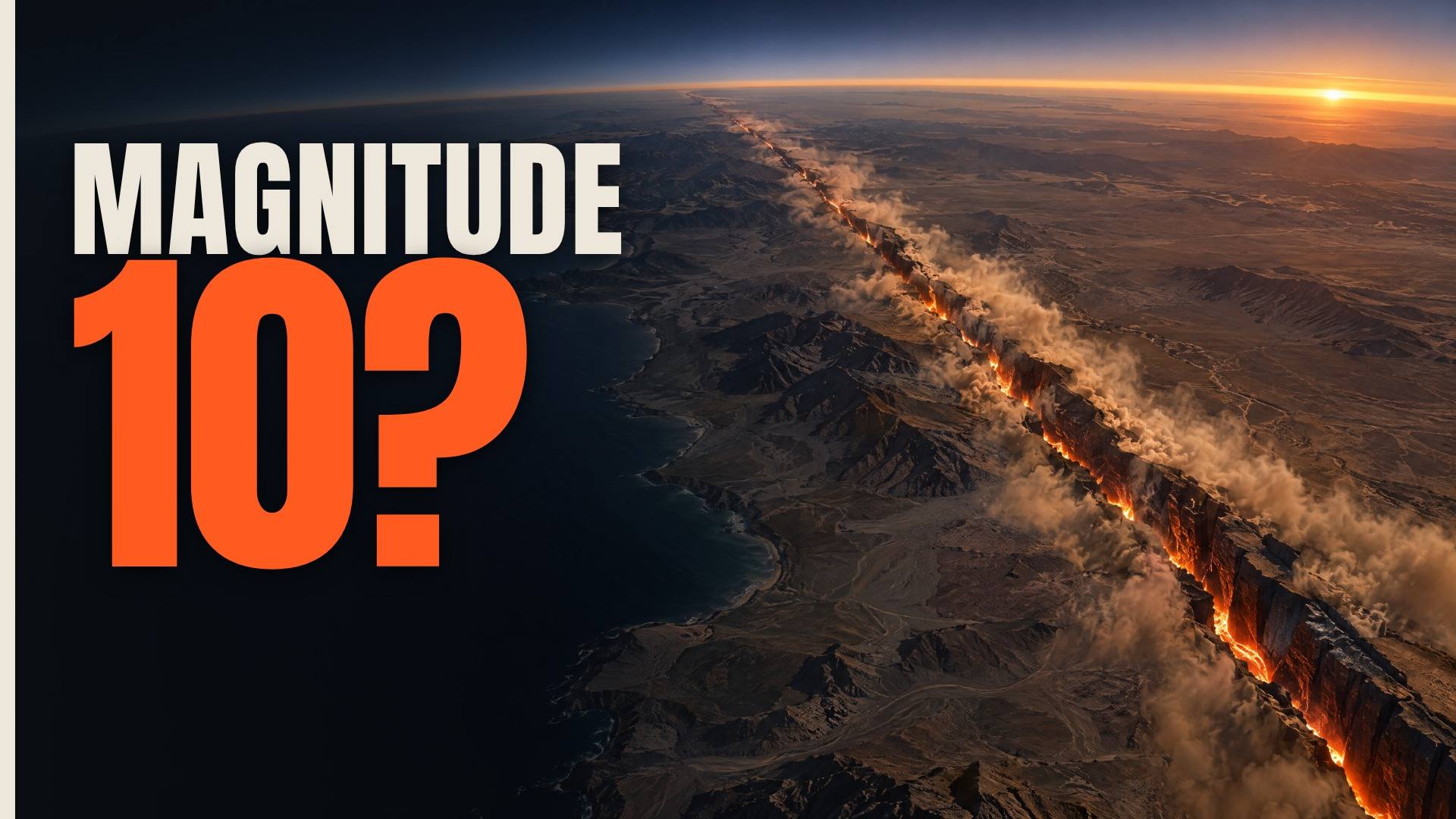
Thumbnail · AI reconstruction
Premieres WED 4 NOV · 10:00 CDMX
The video link appears here once the premiere is scheduled.
Read
Overview
In 1935, Charles Richter called the top of his new magnitude scale "a difficult, and in one sense an unanswerable, question", and guessed that earthquakes of magnitude 10 very probably existed. Today the US Geological Survey says a magnitude 10 cannot happen. The scale itself has no top. The limit is set by the planet.
This episode follows how seismology learned to measure the biggest earthquakes: why Richter's scale saturates, and how Hiroo Kanamori's moment magnitude measures the break in the fault itself. It then looks at the record, Chile on 22 May 1960, magnitude 9.5, and at what earthquakes of that size do to the whole Earth, which rings like a bell after them.
Then it tests the recipe for a magnitude 10. A fault can only lock and break to a limited depth, so a bigger earthquake has to grow along its length. The USGS calculates that a 10 would need a fault about 8,700 miles (14,000 km) long, and even a full rupture of the subduction zone along South America comes out at about 9.86. Statistical studies put the practical ceiling between magnitude 9 and 9.7. The only event in the episode thought to have gone past it was not a fault at all: the Chicxulub asteroid impact.
Key figures
9.5 magnitude
Largest earthquake ever recorded (Chile, 1960)
Source · USGS, 20 Largest Earthquakes in the World Since 1900
8,700 miles
Fault length a magnitude 10 would need (about 14,000 km)
Source · USGS, Earthquake Magnitude, Energy Release, and Shaking Intensity
9.95 magnitude
Every earthquake of the past ~110 years, combined
Source · USGS, Earthquake Magnitude, Energy Release, and Shaking Intensity
The US Geological Survey answers plainly: “No, earthquakes of magnitude 10 or larger cannot happen.” Yet the magnitude scale has no top. So how strong can an earthquake get? The limit is not written on any scale. It is written in the planet, in the size of its faults.
Richter’s unanswerable question
In 1935, the California seismologist Charles Richter published a new way to measure earthquakes. How high it could go, he wrote, was “a difficult, and in one sense an unanswerable, question”. Then he guessed: “there must be cases of at least magnitude 9, and very probably 10.”
Air has a limit for how loud a sound can be, explored in “How Loud Was Krakatoa? The Proof Is on Paper”. Rock has one too, set by its faults.
How the Richter scale works, and where it breaks
Richter used the biggest swing a standard instrument, a Wood-Anderson torsion seismometer, would record 62 miles (100 km) from an earthquake. The scale is logarithmic, so each step up means a swing ten times bigger.
With the biggest earthquakes, the ruler bent. Seismologists call it saturation. Above about magnitude 7, the local scale cannot tell a 7 from something much larger, and later scales run out at around 8.3. A great earthquake breaks a stretch of rock far longer than the waves used to measure it. On those traditional scales, no earthquake ever measured above 8.9.
Moment magnitude
In 1977, Hiroo Kanamori measured the break itself: how stiff the rock is, how large an area gives way and how far the two sides slide. Together they give the seismic moment, and from it the moment magnitude, which does not saturate. Applied to Chile 1960, it came out at 9.5. For large earthquakes, it is the magnitude the USGS reports today.
Each whole step releases about 32 times more energy than the one below it; two steps, about 1,000 times.
Magnitude is not damage
In 2013, a magnitude 8.3 struck about 370 miles (almost 600 km) beneath the Sea of Okhotsk, and the shaking at the surface was moderate. In 2010, a magnitude 7 struck just 8 miles (13 km) beneath Haiti, close to a crowded city, and the shaking was violent. Depth, distance, the ground and the buildings decide the damage. Magnitude only measures size, which makes the question simpler: how big can a fault break?
The strongest earthquake ever recorded
On the afternoon of 22 May 1960, the fault where the Nazca Plate dives beneath South America gave way along about 620 miles (1,000 km) of the Chilean coast, from Lebu to Puerto Aisén. The two sides slid past each other by more than 65 feet (20 m) on average, releasing roughly 300 years’ worth of plate motion at once.
The tsunami took about 15 hours to reach Hawaii and nearly a full day to reach Japan. In Hilo, the first waves after midnight were small, and many people came back. At 1:04 the largest wave struck, and a clock near the shore stopped at that minute. Lives were lost in Hawaii and in Japan.
The USGS lists the earthquake at magnitude 9.5, the largest of the twentieth century. Since 1900, only five earthquakes have reached 9 or more: Chile 1960, Alaska 1964, Sumatra 2004, Japan 2011 and Kamchatka 1952. Even the record is uncertain: depending on the method, 1960 comes out anywhere from 9.2 to 9.6.
A planet that rings like a bell
After 1960, the whole Earth vibrated at its own natural notes, recorded clearly for the first time. The deepest note takes about 54 minutes per cycle. After Sumatra in 2004, the seismologist Jeffrey Park said the planet vibrated “as if it were a bell struck by a giant hammer.”
In 2011, off northeast Japan, the fault moved as much as 165 to 200 feet (50 to 60 m). The day became about 1.8 microseconds shorter, and the axis around which the Earth’s mass is balanced shifted by some 6.5 inches (17 cm). Eighteen hours later, after crossing about 8,450 miles (13,600 km) of ocean, the tsunami reached Antarctica as a swell about 1 foot (30 cm) high. It broke icebergs off the Sulzberger Ice Shelf with twice the surface area of Manhattan.
A century of earthquakes in one number
Add up the energy of every earthquake of the past 110 years or so. According to the USGS, it comes to about magnitude 9.95. Almost half of the release between 1906 and 2006 came from just three earthquakes: Chile 1960, Alaska 1964 and Sumatra 2004.
A magnitude 10 would release about 32 times the energy of a 9, and more than five times the record of 1960: more than a century of earthquakes in one. It would need a bigger fault.
What would a magnitude 10 earthquake need?
The recipe is Kanamori’s: rock stiffness, times the area that breaks, times how far it slips.
The biggest earthquakes happen in subduction zones, where one plate dives beneath another. Only part of that boundary locks. Near the surface, rock and sediment are too soft; deeper than about 25 miles (40 km), it is too hot, and the rock creeps instead of snapping. In the largest earthquakes, the break stops growing at about 125 miles (200 km) across. After that, a fault can only grow along its length.
By the USGS sum, a fault 62 miles (100 km) wide, slipping about 100 feet (30 m), would need to be about 8,700 miles (14,000 km) long: more than a third of the way around the Earth. Not the whole planet, as is sometimes said, but far longer than anything that broke in 1960. A magnitude 10.5 would need about 50,000 miles (80,000 km), twice around the planet.
The longest faults on Earth
If California’s San Andreas broke from end to end, all 870 miles (1,400 km) at once, the result would be about magnitude 8.47. The Peru–Chile Trench runs for about 3,700 miles (5,900 km), the Kuril–Kamchatka Trench for about 1,800 miles (2,900 km). Both are cut into segments, separated by barriers that ruptures rarely or never cross.
Sometimes several segments go together. Ancient tsunami sand along the Kuril Trench points to unusually large events about once every 500 years. In 1700, the Cascadia fault off the Pacific Northwest broke for about 620 miles (1,000 km). In the Atacama Desert, scientists found traces of a rupture of about the same length from some 3,800 years ago, estimated at around 9.5. Nothing found in the rocks so far shows an earthquake clearly larger.
One giant, end to end
The USGS imagined the whole subduction zone along South America breaking at once: 4,000 miles (6,400 km), sliding an average of 130 feet (40 m). The result is about magnitude 9.86, still short of 10.
In 2012, Toru Matsuzawa, a seismologist at Tohoku University, worked out an extreme case: about 1,900 miles (3,000 km) of trench from Japan to Kamchatka, slipping 200 feet (60 m) at once. That, he said, could make a 10, with a rupture lasting 20 minutes to an hour. He called the chances “very low.”
Statistical studies of every subduction zone place the practical ceiling between magnitude 9 and 9.7. The seismologist Heidi Houston puts the limit down to the size of the dipping fault plane.
Beyond the ceiling
Sixty-six million years ago, an asteroid about 6 miles (10 km) wide struck what is now the Yucatán Peninsula, releasing something like 10²³ joules. Only a tiny fraction became seismic waves, yet models suggest shaking beyond magnitude 11, and rocks in Colombia and Mexico carry the marks of an earthquake stronger than 8.5. An impact is not a fault, and its magnitude only compares energy. For a fault to make an 11, it would have to shift along more than 12,000 miles (20,000 km).
What we still don’t know
Is a 10 impossible, or just very unlikely? The USGS has put it both ways. Today it says a 10 cannot happen. In 2008 it said: “Theoretically yes, but realistically the answer is probably no.” In about a century of measurement, statistics would lead us to expect about five earthquakes of magnitude 9. There were five. And the exact size of the record is still debated.
Some of the fastest changes the ground has seen were not made by earthquakes at all, as “The Ice Age Flood That Reshaped the Northwest in Days” shows.
So, how strong can an earthquake get?
The magnitude scale has no upper limit, but the Earth does. Its practical ceiling is around magnitude 9.5, set by how wide and how long a fault can break. The strongest earthquake ever recorded, Chile in 1960, measured 9.5, so the planet may already have come close. A magnitude 10 would need a fault about 8,700 miles (14,000 km) long, and no known fault is long enough.
Chapters
- 0:00 Can a magnitude 10 earthquake happen?
- 1:00 How the Richter scale works
- 2:20 What a magnitude really measures
- 4:00 The strongest earthquake ever recorded
- 6:00 What a magnitude 9 does to the planet
- 7:31 A century of earthquakes in one number
- 8:28 What would a magnitude 10 earthquake need?
- 10:01 The longest faults on Earth
- 11:31 How strong can an earthquake get?
- 12:54 Beyond the ceiling
- 13:48 What we still don't know
Sources & credits
Sources
- 01
- 02
- 03
- 04
- 05
- 06
- 07
- 08
- 09
- 10
- 11
- 12
- 13
Footage and images
USGS (public domain): Hawaiian Volcano Observatory seismogram, Hilo 1988; helicorder bank of the US seismic network, about 1977; 1964 Alaska photographs by W. R. Hansen, G. Plafker and P. J. Haeussler; Landsat images from USGS EROS. NOAA: models by NOAA / PMEL / Center for Tsunami Research (Chile 1960, Tohoku 2011) and the NOAA NCEI travel-time map. NASA / MODIS Rapid Response Team, GSFC; NASA/JPL-Caltech (PIA14430); NASA/JPL (PIA03379). Animations: IRIS/EarthScope, CC BY 4.0 (https://creativecommons.org/licenses/by/4.0/), excerpts shown without their audio. Data: USGS ANSS ComCat; plate boundaries from P. Bird (2003), Nordpil (ODC-By 1.0); Natural Earth.
Some scenes are AI reconstructions or AI illustrations and are labelled on screen. Diagrams are redrawn and simplified. Original music.
Thumbnail: AI reconstruction. Made for Tremor & Tide (Higgsfield, GPT Image 2.5 Sunburst).
AI & archive disclosure
This episode mixes real archive (always labeled) with AI reconstructions and simulations (always labeled). No AI image is presented as a photograph of a real event.
Corrections
No corrections so far. Found an error? Tell us