

Series B · The Day It Happened · Ep. 01 · 15:45 · 1 Nov 2026
How Loud Was Krakatoa? The Proof Is on Paper
Short answer
Krakatoa's 1883 eruption was heard nearly 3,000 miles (4,800 km) away, on the island of Rodrigues. Its loudness in decibels was never measured and cannot be now. What survives is paper: a gasworks pressure gauge about 100 miles (160 km) away went off the scale, and barographs in more than 50 cities recorded its pressure wave at least seven times.
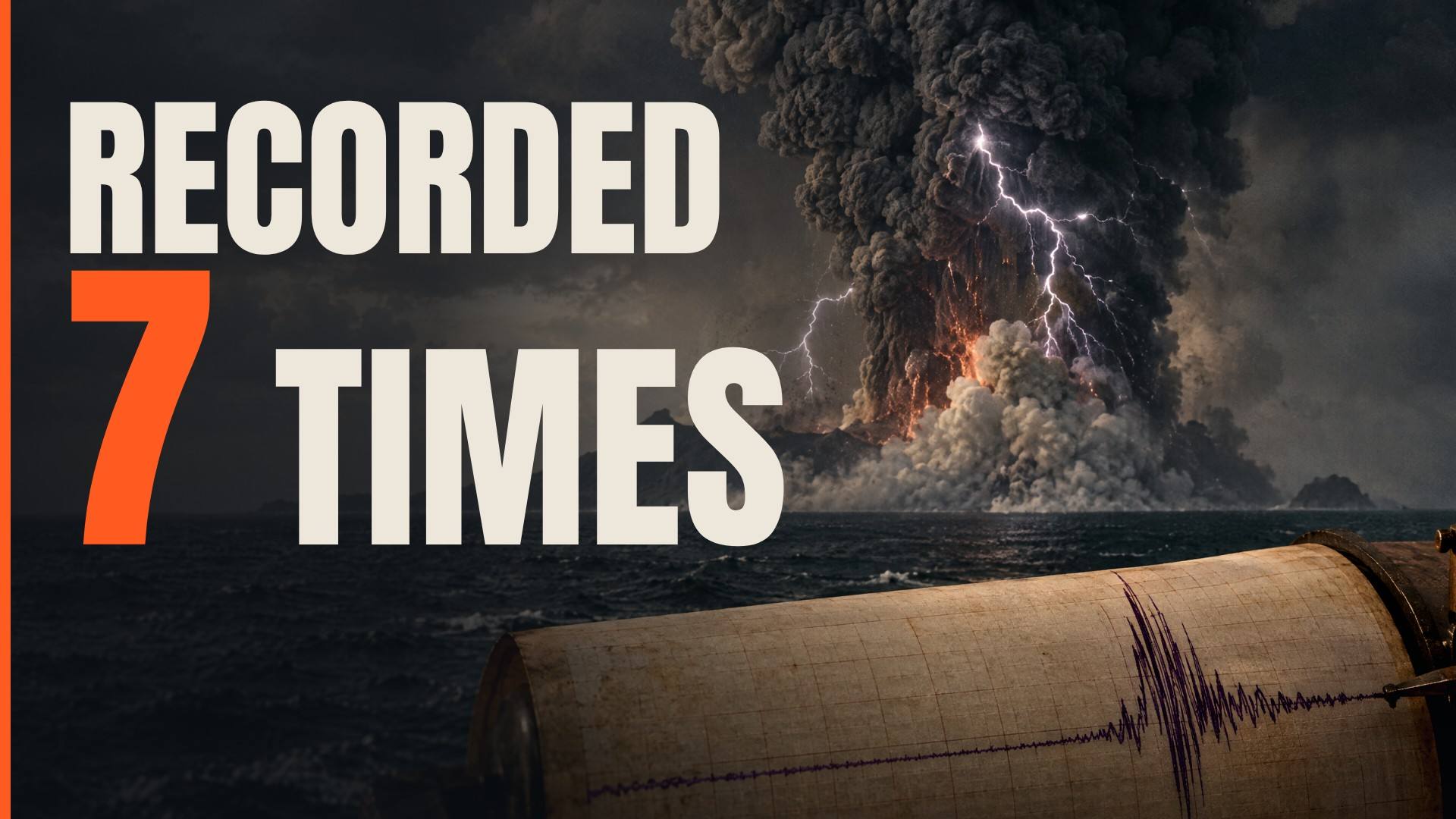
Thumbnail · AI reconstruction
Premieres SUN 1 NOV · 10:00 CDMX
Set a reminder on YouTubeRead
Overview
On the night of August 26, 1883, the chief of police on Rodrigues, in the Indian Ocean, wrote down a sound like distant heavy guns. It came from Krakatoa, nearly 3,000 miles (4,800 km) away. Nobody recorded that sound, so this episode follows the evidence that does exist: paper.
A gasworks pressure gauge in Batavia, about 100 miles (160 km) from the volcano, drew a line that ran off the edge of its chart. Barographs in more than 50 cities recorded the eruption's pressure wave at least seven times as it circled the Earth over about five days, and tide gauges show that the same wave moved the sea. From those traces, Lieutenant-General Richard Strachey worked out the moment of the great explosion.
The episode also looks at why the eruption was so violent, a question scientists still debate; why figures like 310 decibels are not measurements, since sound in air tops out at about 194 decibels; and why Hunga Tonga, in 2022, took one of Krakatoa's records.
Key figures
3,000 miles
Distance at which it was heard (Rodrigues, nearly)
Source · R. Strachey, On the air waves and On the sounds, in the 1888 report (pp. 57–88)
7 passes
Times barographs recorded the pressure wave (at least)
Source · R. Strachey, On the air waves and On the sounds, in the 1888 report (pp. 57–88)
50 stations
Weather stations that recorded the wave (more than)
Source · Gabrielson 2010, Acoustics Today (Krakatoa and the Royal Society)
700 mph
Speed of the pressure wave (about)
Source · R. Strachey, On the air waves and On the sounds, in the 1888 report (pp. 57–88)
Heard nearly 3,000 miles away
On the night of August 26, 1883, James Wallis, chief of police on Rodrigues, a small island in the Indian Ocean, wrote down a sound coming from the east: “like the distant roars of heavy guns”. There were no warships out there. The sound had crossed nearly 3,000 miles (4,800 km) of ocean from a volcano called Krakatoa.
No microphone caught the Krakatoa eruption of 1883. But that day, needles were moving across paper, in a gasworks in Batavia and in weather stations in more than 50 cities. Those traces still exist.
Who heard it
On Diego Garcia, more than 2,250 miles (3,600 km) from the volcano, people took the booms for a ship firing its guns in distress. The sound was heard in many places in Ceylon, today’s Sri Lanka, about 2,000 miles (3,200 km) away, and across Australia, as far as Alice Springs, more than 2,200 miles (3,500 km) away. The area where people heard it covered a little less than one-thirteenth of the Earth’s surface. In 1888, the report called Rodrigues “the only instance on record” of a sound being heard so far from its source.
Close to the volcano, in parts of Java and Sumatra, the booms went quiet soon after ten in the morning, although the explosions had not stopped. The investigators suspected a low screen of ash and debris that blocked the sound from the people beneath it.
The Krakatoa eruption of 1883
Krakatau, as Indonesians call it, sits in the Sunda Strait, between Java and Sumatra. In 1883 it was part of the Dutch East Indies, and the island was three volcanic cones joined together: Rakata, Danan and Perbuwatan. Perbuwatan woke on May 20, 1883, and for three months the volcano grumbled. At two in the afternoon on August 26, the British ship Medea, 76 miles (120 km) away, watched a column of ash rise about 17 miles (27 km).
On the morning of August 27, four explosions were bigger than all the others. The third, around ten o’clock, was by far the most violent. When the ash cleared, about two thirds of the island was gone: Danan and Perbuwatan had vanished, and Rakata had been cut in half. Nobody near the island could record the exact moment of the great explosion.
Why was Krakatoa so loud?
The first investigators, in 1885 and 1888, blamed sea water rushing into the volcano and meeting the magma. In 1981, two volcanologists studied the deposits and found that the great explosions were not driven by that contact.
The answer was inside the magma itself: thick, rich in silica and loaded with gas. About 4 per cent of it, by weight, was water dissolved under pressure, like the gas in a shaken bottle of soda. This magma sat shallow. A study published in 2021 suggests that as the island began to collapse, the weight pressing down on the magma dropped, the pressure fell, and the gas came out all at once. The eruption threw out around 5 cubic miles (20 km³) of rock and ash.
That account is not settled. Nobody knows exactly when the island collapsed, and some scientists think the sea may still have joined in, during or after the collapse.
The pen that ran off the paper
About 100 miles (160 km) from Krakatoa lay Batavia, today Jakarta. Its gasworks stored gas in a giant tank called a gasometer, watched by a pressure gauge whose pen drew a line, day and night, on moving paper. It was never meant to measure a volcano.
On the morning of August 27 the line was jumping. At about a quarter past ten, Batavia time, the report describes “a sudden and most extraordinary increase of pressure”, and on the original record the trace “passes beyond the limits of the diagram”. The pen ran off the paper. One modern estimate turns that reading into more than 170 decibels, but the reading itself is uncertain. The honest version is simpler: it went off the scale.
How loud can a sound get?
Sound is a wave of pressure. At sea level, the air presses down with one atmosphere. A sound wave can push above that, but on the way down it cannot go below zero, because there is nothing less than empty space. That sets a ceiling of about 194 decibels. Past that point, a sound becomes a shock wave, a blast that shoves the air along with it.
So figures like 310 decibels for Krakatoa are not measurements: they would mean pressures of more than 600,000 atmospheres. Clips that claim to play the real sound of Krakatoa are not real either: the phonograph was only six years old, and no recording device was anywhere near the Sunda Strait.
The wave that circled the Earth
The roar people heard faded after a few thousand miles. What crossed the planet was a pressure wave that nobody could hear.
In 1883, weather stations used barographs: barometers with a pen that draws the air pressure on a turning drum of paper. Hours after the eruption, barographs far from Indonesia showed a sudden rise, a dip, then calm. The wave was travelling at around 700 miles an hour (1,100 km/h), close to the speed of sound.
Then it came back: spreading in every direction, the wave met itself on the far side of the planet and rolled back. At many stations it was recorded “not fewer than seven times”: four passes coming from Krakatoa and three coming back from the other side of the world. In Glasgow, the barograph caught all seven over about five days, each lap taking about a day and a half.
Scientists now call this a Lamb wave, a pulse of pressure that hugs the Earth’s surface. Far from the volcano it was a change of a few hundred pascals at most, too small for anyone to feel. But it was there, in ink.
When the air moved the sea
The air wave also pressed on the sea. Tide gauges recorded the water rising and falling by about 11 inches (28 cm) at Le Havre in France, about 9 inches (24 cm) at Plymouth in England and at South Georgia near Antarctica, and about 8 inches (20 cm) at Colón in Panama. Long thought to be the tsunami itself, these small waves were shown in the 1950s to have arrived with the air wave. Today they are called volcanic meteotsunamis.
Close to the volcano, waves swept the coasts of the Sunda Strait. At Merak, on Java, people at the time estimated the water rose about 130 feet (40 m). Anjer, on Java, and Teluk Betung, on Sumatra, were largely swept away. More than 36,000 people died, the great majority killed by the water, not by the explosion.
How the explosion was timed from London
In January 1884, the Royal Society in London set up a Krakatoa Committee and asked the world for evidence, from ship logs to barograph traces. The pressure records went to the Meteorological Office, and their analysis was presented by Lieutenant-General Richard Strachey.
Strachey had dozens of stations, each with a different arrival time. Comparing those times with each station’s distance from Krakatoa, he worked out the speed of the wave, then traced every line back to a single moment: 2 hours and 56 minutes, Greenwich time, just before ten in the morning at Krakatoa. Nobody at the volcano had clocked it. It was calculated from paper, on the other side of the world.
Is Krakatoa still the loudest sound on record?
For more than a century, no sound on record had been heard farther away. Then, on January 15, 2022, Hunga Tonga Hunga Ha’apai, an underwater volcano in the South Pacific, exploded. People heard it across Alaska, as far as 6,200 miles (10,000 km), about twice as far as Krakatoa. A study in the journal Science found its pressure wave comparable in size to Krakatoa’s, although Krakatoa’s pulse lasted longer.
So Krakatoa is no longer the sound heard farthest away, and decibels cannot settle the comparison: neither eruption was measured that way. Tambora, in 1815, was a bigger eruption, but Krakatoa was heard much farther away. What Krakatoa still holds is the evidence: a worldwide paper trail, written by machines in 1883. The instruments that caught Tonga are their descendants.
What we still don’t know
Two questions remain open: exactly when the island collapsed that morning, and whether the sea played a part in the final blast. Where Krakatoa stood, a new volcano has grown out of the sea: Anak Krakatau, the Child of Krakatoa. It is still active, and still watched.
The air has a ceiling of around 194 decibels. Whether the ground has one too is the question of the next episode, “How Strong Can an Earthquake Get? Earth Has a Limit”.
So how loud was Krakatoa?
Loud enough to be heard nearly 3,000 miles (4,800 km) away, and to send a pen off the edge of its paper about 100 miles (160 km) from the volcano. Powerful enough that instruments in more than 50 cities recorded its pressure wave again and again, for five days. Its loudness in decibels was never measured, and never can be. No one recorded the sound, but the whole planet took notes.
Chapters
- 0:00 Heard nearly 3,000 miles away
- 2:39 Krakatau and the four explosions
- 4:09 Why was Krakatoa so loud?
- 6:06 Batavia: the pen that ran off the paper
- 7:22 How loud can a sound get?
- 8:34 The wave that circled the Earth
- 10:13 When the air moved the sea
- 11:45 The proof on paper
- 13:13 Is it still the loudest sound on record?
- 14:23 What we still don't know
Sources & credits
Sources
- 01
- 02
- 03
- 04
- 05
- 06
- 07
- 08
- 09
- 10
- 11
- 12
Footage and images
Plates and pages from the Royal Society report, 1888 (public domain, Internet Archive). Leiden University Libraries (public domain): KITLV 5888, KK 027-01-07, KK 026-05-01 and Verbeek's Krakatau. Library of Congress, Chronicling America: The Sun (New York), 28 August 1883; The Daily Dispatch (Richmond), 28 December 1883. NASA Earth Observatory images by Michala Garrison, using Landsat data from the U.S. Geological Survey. NASA Worldview, GOES-West GeoColor (NOAA / NESDIS). Maps: Natural Earth.
Some scenes are AI reconstructions and are labelled on screen. Diagrams are redrawn and simplified. Original music.
Thumbnail: AI reconstruction. Made for Tremor & Tide (Higgsfield).
AI & archive disclosure
This episode mixes real archive (always labeled) with AI reconstructions and simulations (always labeled). No AI image is presented as a photograph of a real event.
Corrections
No corrections so far. Found an error? Tell us